



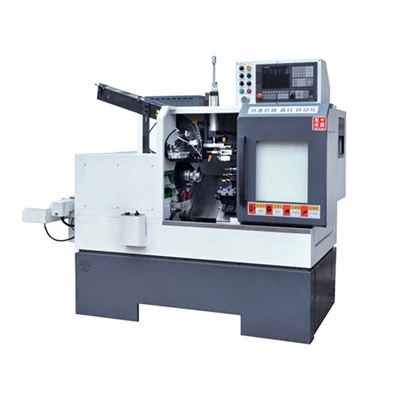
Flat Bed CNC Lathe Machine
Flat bed CNC lathe is a general-purpose machine for machining short shafts, stepped shafts, and tubular parts. Featuring stable structure and large working space, it flexibly performs complex operations including cylindrical turning, facing, grooving, and internal/external threading. With excellent cost-effectiveness, it efficiently handles variety and small-batch production tasks of diverse rotational parts, serving as reliable basic equipment for integrated machining of complex operations.

Specifications
|
Model |
0640 |
|
Feeding Method |
Front feeding (cylinder feeding) |
|
Filling Method |
Vibratory bowl feeder (optional elevator) |
|
Discharge Method |
Spring ejection (optional parts receiver + conveyor belt) |
|
Workpiece Length |
10-80mm |
|
Bed Configuration |
Integral flat bed with linear guideways |
|
Control System |
CNC system + PLC |
|
Spindle Structure |
Front 3 + rear 2 bearings (optional spindle unit) |
|
Spindle Nose |
A2-5 |
|
Spindle Speed |
50-3000 RPM |
|
Broached Through-Hole |
φ40mm (max. bar stock passage diameter) |
|
Clamping Method |
Hollow rotary hydraulic cylinder |
|
Spindle Fixture |
0640 collet chuck (optional hydraulic chuck) |
|
Motor Power |
4 KW/5.5 KW |
|
Tool Holder Type |
Gang tool post (optional servo turret) |
|
Chip Removal Method |
Right-side chip discharge |
|
X/Z-axis Rapid Traverse Speed X/Z |
15m/min |
|
Maximum X/Z-axis Travel X/Z |
600mm/200mm |
|
Total Machine Weight |
Approx. 1000kg |
|
Overall Dimensions |
1750×1300×1750 (L×W×H) |
Scope of Application
Suitable for the automated, high-precision machining of complex operations on short shafts, stepped shafts, disc-shaped parts, and tubular components.
Equipment Manufacturing Process
The manufacturing process of mechanical equipment is a typical "design – process – manufacturing – delivery" closed loop, with the core objective of transforming engineering drawings into physical products while ensuring performance. Below is the breakdown of the standard process:
Core Manufacturing Process
Design Input: Define hard specifications such as equipment function, accuracy, and production capacity. Deliverables include general assembly drawings, sub-assembly drawings, and part drawings.
Process Planning: Establish machining routes (turning / milling / heat treatment), fixture and tooling plans, and quality control (QC) points.
Part Machining: Material cutting → rough machining (stock removal) → heat treatment (quenching and tempering / hardening) → finishing (grinding / fine turning) → special treatments (chrome plating / powder coating).
Assembly & Commissioning: Sub-assembly → final assembly → accuracy adjustment (leveling / parallelism) → no-load and load testing → performance acceptance.
Delivery & Maintenance: Factory acceptance testing → packaging and shipping → on-site installation → operation training → after-sales maintenance.
About Qiyang
Taizhou Qiyang Trading Co., Ltd. is a high-tech enterprise dedicated to the research and development, manufacturing, and sales of automated hardware machinery and precision CNC machine tools. By integrating advanced manufacturing expertise and technological resources from across the industry, the company is committed to providing global clients with high-quality machine tools and professional machining solutions.

FAQ
Q1. What are the advantages of a flat bed CNC lathe?
A: The core advantages of a flat bed CNC lathe include high rigidity, strong load capacity, excellent impact resistance, good damping characteristics, high surface finish on machined parts, and relatively controllable maintenance costs. The essence of maintenance can be summarized as "prevent scoring, ensure lubrication, and adjust clearance."
Q2. Three core pain points of flat bed maintenance (differences from linear guideways)
A: 1) Prevent scoring – Flat bed guideways have large sliding surfaces, making them prone to adhesion of chips and coolant. Once chips are dragged between the guideway and the carriage, they cause scoring (galling), which is an irreversible damage. Daily cleaning is mandatory.
2) Prevent stick-slip – Flat bed guideways rely on surface-to-surface friction. If lubrication is insufficient or the oil film breaks, low-speed operation may result in a "jerky" stick-slip phenomenon, affecting machining accuracy.
3) Adjust clearance – Flat bed guideways typically use a gib strip (tapered gib) to adjust guideway clearance. Prolonged use leads to wear. Excessive clearance causes wobbling, while over-tightening leads to overheating and rail damage. Regular adjustment is required.
Hot Tags: flat bed CNC lathe machine, China flat bed CNC lathe machine manufacturers, suppliers, factory
You Might Also Like




Send Inquiry