



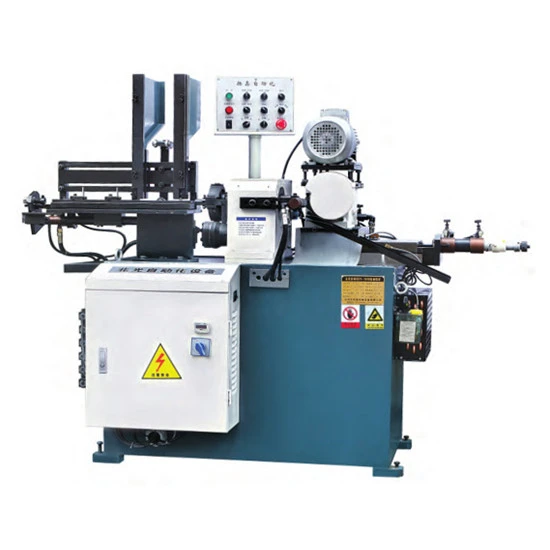
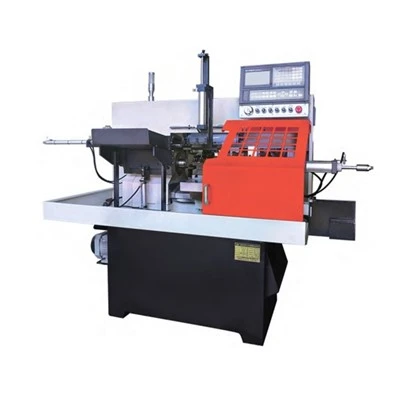
Automatic Milling Machine
Core advantage of automatic milling machine is replacing traditional manual operation with automatic control, achieving production mode upgrade from "single operator, single machine, single control" to "single operator, multiple machines in attendance". It not only eliminates human operation error through preset program, significantly improving dimensional consistency and machining accuracy of batch workpieces, but also greatly reduces auxiliary idle time, maximizing continuous machine operation efficiency.
Additionally, enclosed automatic machining effectively isolates cutting area, reducing labor intensity while greatly improving operational safety. Automatic milling machine is key equipment for manufacturing industry to achieve cost reduction, efficiency increase, stable quality, and large-scale production.

Specifications
|
Model |
Model 25, Model 32 |
|
Milling Length |
0-25 mm |
|
Workpiece Length |
70-300 mm |
|
Workpiece Diameter |
Φ4-20 mm |
|
Workpiece Shape |
Round, square, hexagonal |
|
Edging Method |
Rear feeding |
|
Motor Power |
1.5 KW |
|
Spindle Speed |
1500 RPM |
|
Power Supply |
380V 50Hz (three-phase four-wire) |
|
Indexing Range |
2, 3, 4, 6 divisions |
|
Total Machine Weight |
Approx. 620 kg |
|
Overall Dimensions |
2500×800×1500 (L×W×H) |
Scope of Application
Suitable for automated single-side and multi-side machining of various long and short shaft parts in batch production.
Equipment Manufacturing Process
Requirement Communication & Solution Confirmation
Fully communicate with customer to clarify machining object, process requirement, accuracy specification, production capacity target, budget, and timeline. Based on technical feasibility, determine equipment structure type, main function configuration, and technical parameters. Output preliminary solution and quotation.
Contract Signing & Production Launch
After both parties confirm solution, sign formal contract, specifying delivery time, payment method, and acceptance standard. Customer pays advance payment as agreed. Factory issues production task order, initiating design freeze, material procurement, and production scheduling.
Complete Machine Assembly & In-house Debugging
After material readiness, enter assembly stage. Complete bed, worktable, spindle headstock, and other major component assembly in sequence. Connect transmission, lubrication, cooling, and electrical systems. After assembly completion, perform power-on debugging, no-load operation, and geometric accuracy inspection. Conduct test cutting of typical workpiece to verify machining accuracy, stability, and production efficiency, ensuring compliance with contract technical requirements.
Pre-acceptance
Invite customer to factory or conduct pre-shipment acceptance via video. Demonstrate equipment function and machining result. After both parties confirm qualification, sign pre-acceptance report.
Shipment & Delivery
After customer pays contract balance, reinforce packing with wooden case or strapping. Arrange logistics transport to designated delivery location. Transaction completes after customer signs receipt.
About Qiyang

Taizhou Qiyang Trading Co., Ltd. is a high-tech enterprise dedicated to the research and development, manufacturing, and sales of automated hardware machinery and precision CNC machine tools. By integrating advanced manufacturing expertise and technological resources from across the industry, the company is committed to providing global clients with high-quality machine tools and professional machining solutions.
FAQ
Q1. What is automatic milling machine? Difference from conventional manual milling machine?
A: Automatic milling machine refers to milling machine with automatic feed, automatic cycle, or CNC system, capable of automatically completing table/spindle movement, tool change (for machining center type), cutting, and other actions according to preset program. Manual milling machine requires operator to manually hand-feed and frequently touch off tool. Automatic milling machine, after clamping, automatically feeds according to program/cam/hydraulic cycle, offering more stable accuracy and suitability for batch continuous machining.
Q2. Common types of automatic milling machine?
A: Conventional automatic feed milling machine: adds automatic feed mechanism (mechanical/hydraulic cycle) to conventional horizontal/vertical milling machine, suitable for batch machining of simple flat surfaces/slots. CNC milling machine (CNC mill): automatically completes multi-axis linkage, contour/cavity machining according to G-code. Special-purpose automatic milling machine (e.g., automatic double-sided/multi-sided milling, rotary table automatic milling): equipped with automatic loading/unloading or indexing device, dedicated to high-volume machining of specific part types.
Hot Tags: automatic milling machine, China automatic milling machine manufacturers, suppliers, factory, Automatic Tapping Machine, Front Feeding CNC Automatic Lathe, Hydraulic Automatic Lathe, Post Feeding CNC Automatic Lathe, Precision Automatic CNC Lathe Machine, Tailstock CNC Automatic Lathe
Previous
Multi-Axis Milling MachineNext
No InformationYou Might Also Like


Send Inquiry